
The financial sustainability of the SA municipal sector remains very weak with a few beacons of hope
On 3 October 2025, Ratings Afrika published its annual Municipal Financial Sustainability Index (MFSI®) for the financial results of the 107 largest local municipalities plus the 8 metros in South Africa, thus 115 in total. The analyses are based on the municipal financial year ending in June 2024.
Ratings Afrika is an independent governance ratings agency that considers financial sustainability a key component of sound governance. Ratings Afrika established the MFSI® as a measurement for the financial sustainability of municipalities. The MFSI® was introduced to the South African market in 2011.
The MFSI® is in line with Ratings Afrika’s definition of municipal financial sustainability, stated as: “The financial ability of a municipality to deliver services, develop and maintain the infrastructure required by its residents without unplanned increases in rates and tariffs or a reduction in the level of services. Additionally, the municipality should have the capacity to absorb financial shocks caused by natural and economic disasters; political and other adversities, without external financial assistance.”
The Municipal Financial Sustainability Index (MFSI®)
The MFSI® is a meticulously designed scoring model that evaluates six financial components of a municipality. The components are the operating performance, liquidity management, debt governance, budget practices, affordability and infrastructure development. Each component is given a score and they are weighted together. This measurement produces a ranking on our index against a benchmark of 100, which would indicate a level of ‘undoubted’ financial sustainability for a municipality.
The MFSI® criteria were developed using leading international and local credit analysis and financial stability criteria combined with practical experience in this field. The MFSI® is the most comprehensive assessment of its kind publicly available in South Africa. Furthermore, when considered over time, the MFSI® provides a clearly visible trend of the financial sustainability of a municipality over a number of years.

Overview of the Municipal Sector’s Financial Position in 2024
Commentary on South Africa’s local government is specific to the 115 municipalities included in Ratings Afrika’s 2024 MFSI® analyses. Opinions on the operating performance, financial management and the effect on the South African economy is informed by our data-driven scoring model that analyse publicly available credible information and statistics. Ratings Afrika’s opinions are independent, unbiased and apolitical.
The results of Ratings Afrika’s latest MFSI® once again confirm the very weak financial sustainability of the South African municipalities under the leadership of the current elected councillors and their appointed executive management teams. The exception is the majority of the Western Cape municipalities and Midvaal in Gauteng.
Ratings Afrika has been warning of this disastrous trend since 2011, that has rapidly escalated in last few years. Residents and businesses are suffering from poor, and in some cases almost non-existent service delivery. Economic growth is threatened by the inability to maintain and develop infrastructure.
A most important additional point is that Eskom and the water utilities are dependent on municipal payments to remain viable themselves.
All-in-all, Central Government needs to realise in more practical terms that well-run, efficient municipalities that provide high-quality services to its residents and support local businesses, are the underpin to economic growth and wealth of the country.
Operating Performance and Liquidity
The two key forces that drive a municipality’s financial sustainability are the generation of operating surpluses and positive working capital (liquidity or cash) balances. However, through gross financial mismanagement and unsound governance the majority of the South African municipalities are still operating at deficits. For the 2024 municipal financial year, the aggregate operating deficits for the 115 municipalities included in Ratings Afrika’s MFSI® amounts to R35 billion, up R8 billion from 2023. The effect of these operating deficits is that the municipalities do not generate sufficient funds from their operations to fund the services they are supposed to deliver. Very poor service delivery is the consequence. Furthermore, they do not generate any funds to invest in infrastructure for the betterment of the residents.
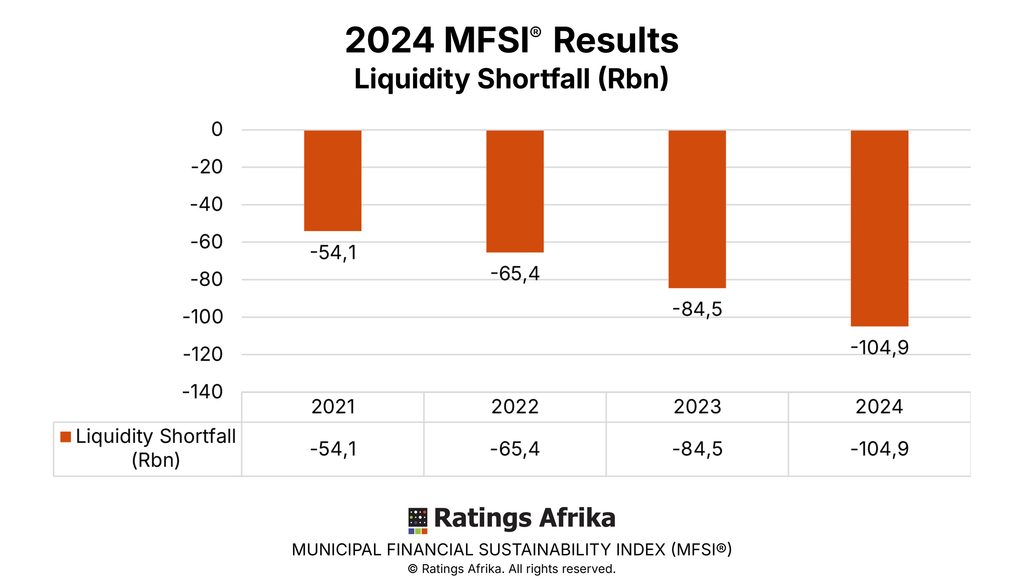
These operating losses have over time culminated in huge working capital (liquidity) shortfalls for most of them. A liquidity shortfall arises when the municipality does not have enough cash and liquid assets to meet its immediate financial obligations. As depicted in the graph, the aggregate liquidity shortfall for the 115 municipalities is a staggering R104,9 billion for 2024, up R20 billion from R85 billion in 2023 which is also an increase of R20 billion from 2022. This figure only includes the 115 largest municipalities and could be much larger for all 257 municipalities in the country.
As determined by Ratings Afrika’s 2024 MFSI®, of the R104,9 billion liquidity shortfall about R80 billion is owed to Eskom. This increased to about R100 billion in 2025.

Majority of municipal liquidity shortfall is owed to Eskom, currently 100 billion in 2025
As a result of these liquidity shortfalls, service delivery is breaking down in most municipalities and that infrastructure is crumbling at an unprecedented pace throughout. At this rate South Africa faces a calamity of major proportions if this lack of sustainability is not dealt with effectively and as a matter of urgency.
The practical reality of the liquidity shortfalls is that these municipalities do not have the cash available to pay their service providers, such as Eskom, the water utilities and other creditors, within 30 days as required by the Municipal Finance Management Act (MFMA). Without working capital, it becomes almost impossible for these municipalities to provide an acceptable level of services. This might lead to a material breakdown in service delivery with catastrophic consequences for residents and businesses; which in turn could continue to encourage political unrest.
Contributing to the cash shortfall is the very low average revenue collection rate of only 81,2%. The Western Cape municipalities’ collection rate at 92,1% is the only provincial average that is close to the benchmark of 95%. The metros do not perform much better than the local municipalities, with an average collection rate of 86,1%. Cape Town is the exception with a collection rate of 96,6%. The very low average collection rates show a lack of commitment from, or inability of, the management and political leaders to collect what is due for services delivered and for property rates.
The liquidity shortfalls are expected to get worse every year since the majority of the municipalities will continue to realise losses, and revenue collection is expected to remain subdued because of the slow economic growth. Without the necessary liquid funds, service delivery in most municipalities will continue to worsen.
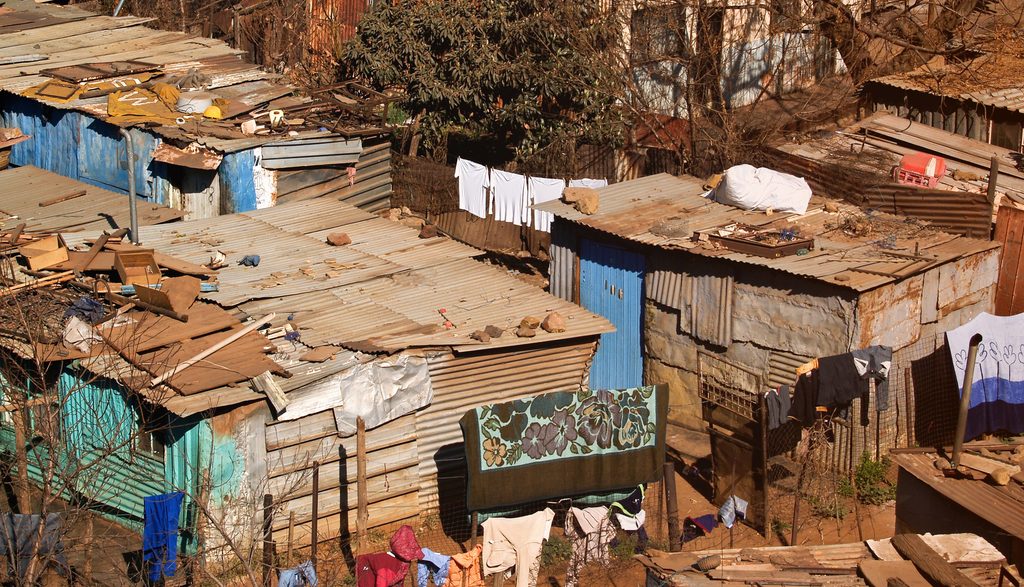
The majority of South Africa’s municipalities are operating at deficits
Provincial and Metro MFSI® Performance
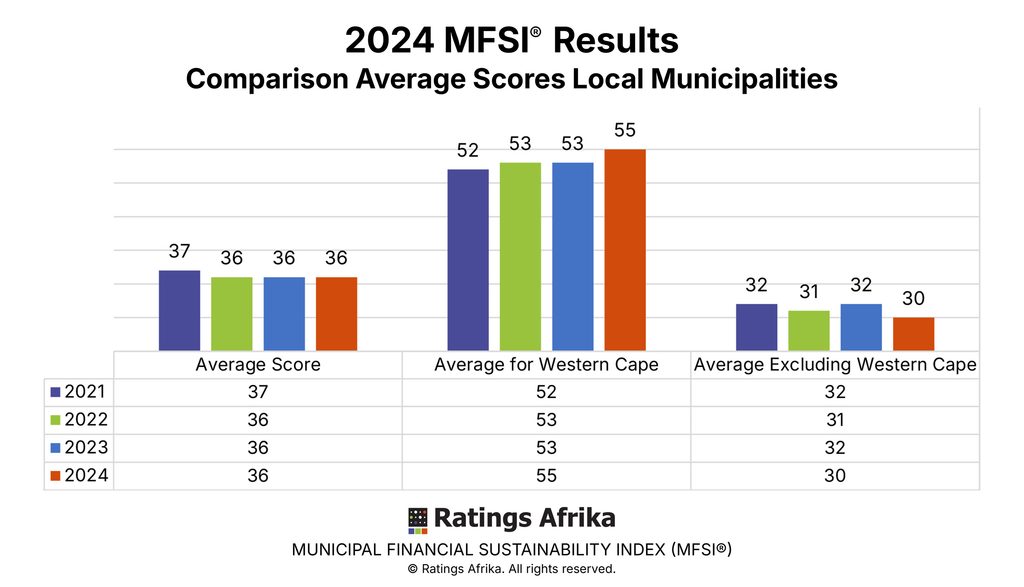
From the 115 municipalities in South Africa covered in Ratings Afrika’s analyses, the average score for the local municipalities for 2024 remains very low at 36 out of 100. They received this score also for the previous two years. However, the average is propped up by the Western Cape municipalities.
Western Cape, with an average of 55, is the highest-scoring province. It is the only province with an average of more than 50 and also the only province whose municipalities are considered to be largely sustainable financially.
Comparison Average Scores of Local Municipalities and Western Cape 2021 – 2024
However, the average score for the municipalities, excluding that of the Western Cape, is an extremely low 30 out of 100 which is a decline from 32 in 2023. This indicates very poor financial management practices and discipline. This is rendering the majority of the municipalities seriously unsustainable and perhaps even dysfunctional in terms of normal service delivery. A common feature of the municipalities with the lowest scores is that their liquidity positions are extremely weak. Their operating revenue and expenditures are not evenly matched, resulting in relatively large operating deficits. The quality of their infrastructure is deteriorating, caused by low spending on repairs and maintenance which could threaten long-term service delivery and sustainability. The going-concern status of these municipalities is extremely doubtful.
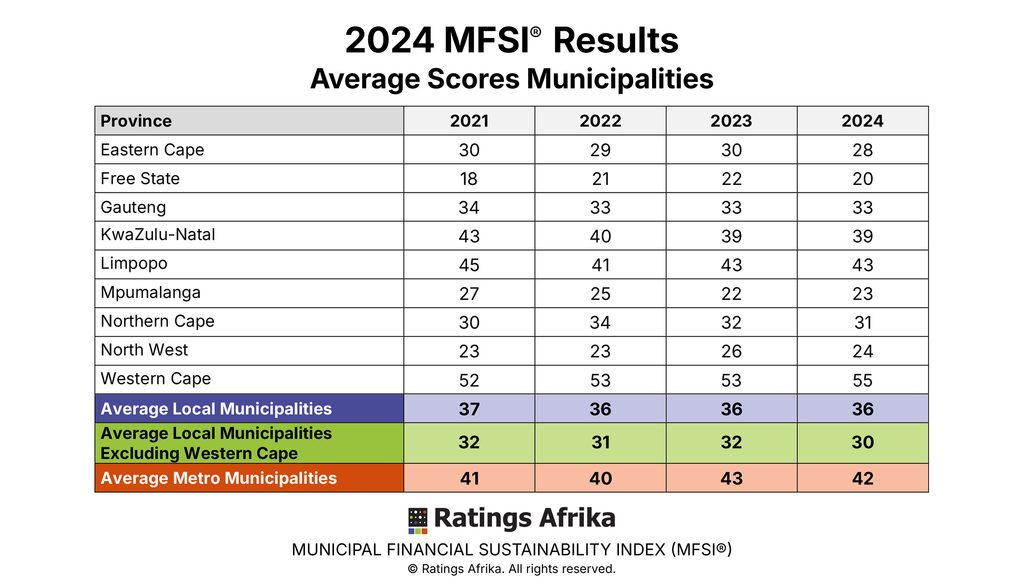
Average Scores Local and Metropolitan Municipalities 2021 – 2024
The average score for the metros is showing a slight decline with one point, from 43 in 2023 to 42 in 2024. At this level of financial sustainability the majority of the metros, except City of Cape Town, remain a concern. They are considered to be the economic engines of the South African economy. Service delivery failure by the metros can cause immeasurable damage to the economy.
It is clear that the majority of the municipal councils have failed miserably in their governance responsibilities by allowing them to sink into this desperate, unsustainable financial situation. Furthermore, it seems that the oversight role by the respective provincial administrations, other than in the Western Cape, has so far been ineffective in improving the financial sustainability at municipal level, as the situation has been continuing unchecked for many years.

Best Performing Municipalities
Ratings Afrika’s 2024 MFSI® results of the 107 largest local municipalities and 8 metros in South Africa analysed are as follows:
The Best Performing Municipalities by Province for 2024
Eastern Cape – Kouga Municipality
Free State – Metsimaholo Municipality
Gauteng – Midvaal Municipality
KwaZulu-Natal – KwaDukuza Municipality
Limpopo – Greater Tzaneen Municipality
Mpumalanga – City of Mbombela
Northern Cape – Dawid Kruiper Municipality
North-West Province – JB Marks Municipality
Western Cape – Saldanha Bay Municipality and Swartland Municipality
*Listed alphabetically according to province, not score achieved
The Best Performing Municipalities in South Africa for 2024
1st Place
Saldanha Bay Municipality and Swartland Municipality (joint first place)
2nd Place
Swellendam Municipality
3rd Place
Hessequa Municipality
Best Metropolitan Municipality
City of Cape Town
Saldanha Bay and Swartland Municipalities are jointly in the first place, each with a score of 74. Swellendam Municipality is in the second place with a score of 73. Hessequa Municipality is in third place with a score of 72.
These high-scoring municipalities demonstrate consistency over the last five years. They normally have well-entrenched financial policies and their budgets are based on sound long-term financial strategies. They adhere to good budgetary practices, strict financial control and good revenue collection even through tough economic conditions. The sound levels of financial sustainability place these municipalities in a very strong position to invest in infrastructure and it gives them the capacity to absorb financial shocks.
Cape of Town is the only metro that is still considered to be highly sustainable financially in 2024 with a score of 70, outperforming the rest of the metros by a large margin. Its achievement is remarkable considering that the average of the metros is only 42 in 2024. Underpinning Cape Town’s high score is a sound operating surplus high levels of cash reserves that can be utilised for infrastructure development and provide a considerable buffer to absorb financial shocks.
Nelson Mandela Bay is the only other Metropolitan Municipality whose financial sustainability could be considered fair with its score of 50 in 2024.
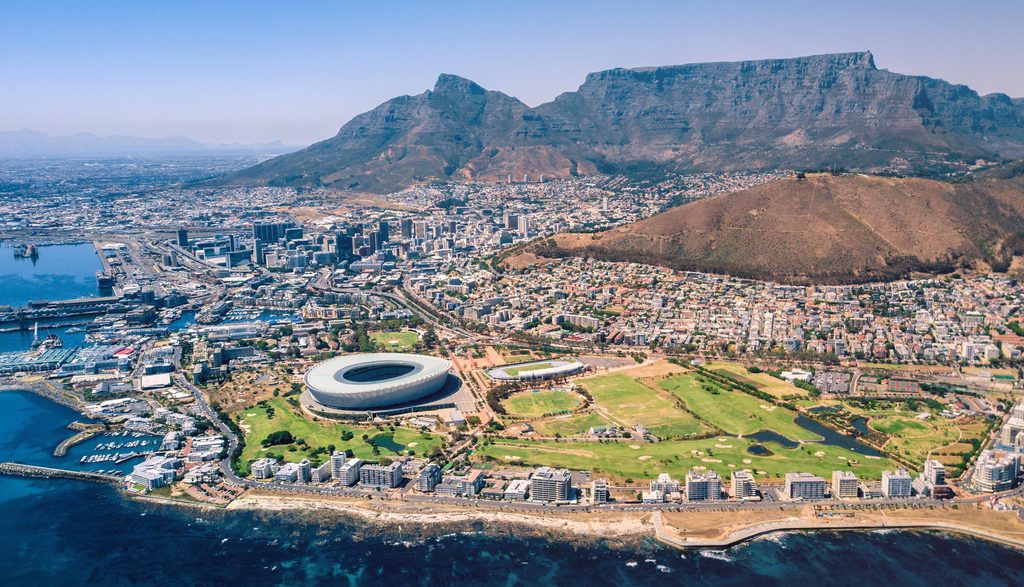
As depicted by the results of the latest MFSI® by Ratings Afrika, the financial sustainability of the majority of the municipalities, and concomitantly their service delivery capacity, remains dismal and continues to deteriorate rapidly – which has a disastrous effect on the quality of life for most of the South African population and the economic activity of the businesses located within their jurisdictions.
Presently it is only a large number of the Western Cape municipalities that demonstrate adequate levels of financial sustainability, giving them the financial capacity to deliver services and develop infrastructure while at the same time building the reserves to absorb financial shocks. The other provinces could take guidance from the Western Cape municipalities on how to run financially sustainable municipalities.
Unless there is a concerted effort from the municipalities themselves, the provinces and national government to strengthen their governance and financial management this very bad situation will continue. Service delivery will break down further, the quality of life for most residents will deteriorate and economic activity will be stifled.
Ratings Afrika: www.ratingsafrika.com
Contact
Leon Claassen
Managing Executive
Mobile: +27(0) 82 443 4046

0 Comments