
The City Of Gold Has Lost Its Shine
The City of Gold is losing its shine. Once the economic engine of South Africa and the financial capital of Africa, Johannesburg is now a municipality in deep financial distress. Years of poor governance, weak financial management and deteriorating fiscal discipline are eroding service delivery, undermining infrastructure and threatening the city’s economic future.
Johannesburg, established in 1886 following the discovery of gold on the Witwatersrand Reef, is affectionately known as “The City of Gold.” It is South Africa’s largest and wealthiest metropolitan municipality, renowned for its rich mining history, industrial base, world-class financial institutions and significant contribution to the national economy.
Often described as the economic powerhouse of Africa, the City of Johannesburg contributes approximately 16% of South Africa’s Gross Domestic Product (GDP), making it the single largest metropolitan contributor to the country’s economy. According to the 2022 Census, the city’s average annual household income was R280,416, the third highest in South Africa and well above the national average of R204,359. The Census recorded a population of 4,8 million, although more recent estimates place Johannesburg’s population at approximately 6,5 million.
Despite its enormous economic potential, Johannesburg has become a municipality in deep financial distress. This growing financial instability is increasingly undermining service delivery, accelerating infrastructure decay and constraining economic growth.
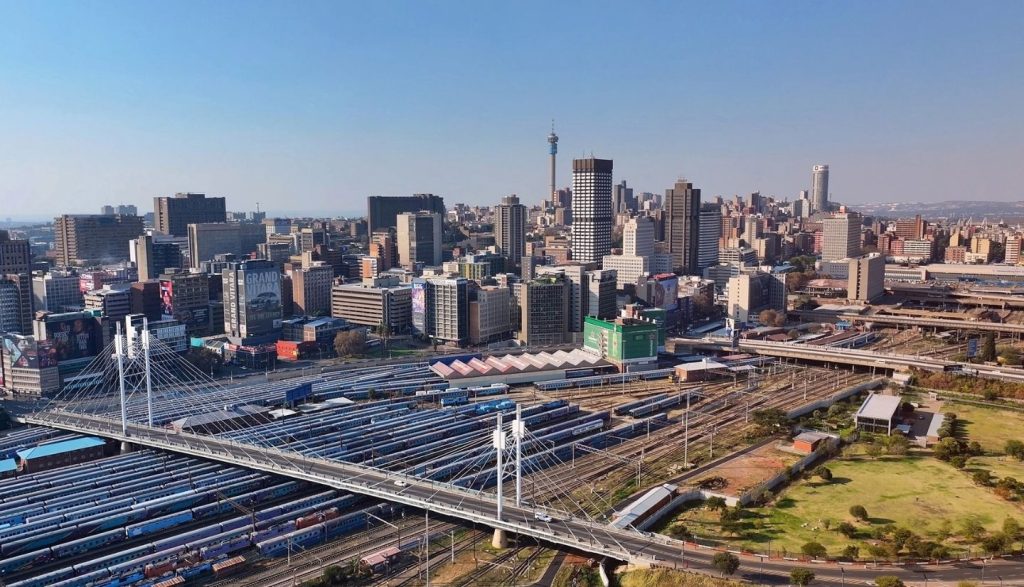
Johannesburg is in deep financial distress
Ratings Afrika’s Municipal Financial Sustainability Index (MFSI®)
Independent governance ratings agency Ratings Afrika, has monitored South Africa’s municipal sector since 2011. Ratings Afrika’s annual Municipal Financial Sustainability Index (MFSI®) assesses the financial health of South Africa’s 120 largest local municipalities and eight metropolitan municipalities. Over many years, the Index has consistently proven to be one of the country’s most reliable indicators of municipal functionality and service delivery.
Municipalities that consistently achieve high MFSI® scores are generally well-managed, financially sustainable and capable of delivering reliable services. They tend to be attractive places in which to live and invest. By contrast, municipalities with persistently low scores typically display signs of financial distress, deteriorating infrastructure, weak governance and declining service delivery.
Unfortunately, Johannesburg falls firmly into the latter category.
Johannesburg’s MFSI® scores over the past decade paint a troubling picture of sustained financial decline.
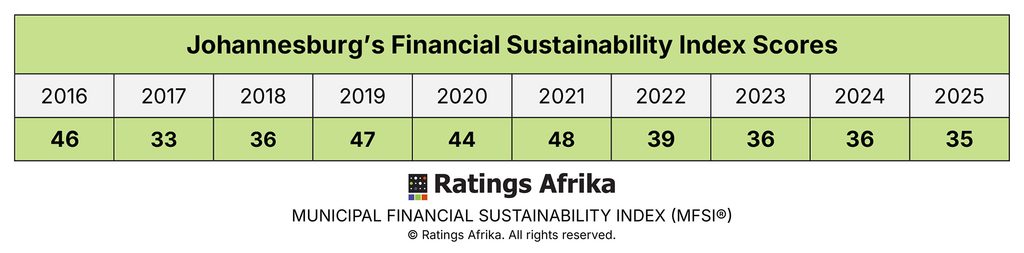
Johannesburg’s MFSI® scores over the past decade
Johannesburg’s score of 35 out of 100 in 2025 reflects a municipality with low financial sustainability and continues a clear downward trend over the past decade. It also falls below the average score of 40 achieved by South Africa’s eight metropolitan municipalities in 2025, an average that is itself cause for serious concern regarding the overall financial health of the country’s metros.
The notable exception is Cape Town, which has consistently maintained a high level of financial sustainability over the past five years.
Johannesburg’s persistently low scores highlight severe weaknesses in financial management, governance and fiscal discipline. As a consequence, the City’s ability to provide reliable basic services is steadily deteriorating. Residents and businesses increasingly experience poor service delivery and, in many instances, complete service failure. At the same time, the municipality is struggling to maintain existing infrastructure, further compounding these challenges.
This trend is more than an indication of financial distress, it demonstrates a municipality whose declining financial position is increasingly undermining service delivery, infrastructure sustainability and economic growth.
Overview of Johannesburg’s Financial Position in 2025
Long-term financial sustainability depends primarily on two factors: the ability to generate consistent operating surpluses and the maintenance of adequate liquidity. Johannesburg is failing on both counts.
Despite repeated warning signs, Johannesburg continues to operate at a substantial deficit due to poor financial management, weak governance and inadequate fiscal discipline.
For the 2025 financial year, Johannesburg recorded an operating deficit of R2,8 billion. Although this represents an improvement from the R4,4 billion deficit reported in 2024, it remains unacceptably high. Operating expenses are clearly too large for the revenue base. Johannesburg is therefore simply not generating sufficient operating revenue to fund essential municipal services, resulting in declining service delivery and an increasing inability to invest in and maintain critical infrastructure.
The cumulative effect of four consecutive years of operating losses has been a dramatic deterioration in the City’s liquidity position. What was a liquidity surplus of R2,6 billion in 2021 has deteriorated into a liquidity shortfall of R10,1 billion by 2025.
Johannesburg’s Liquidity Position
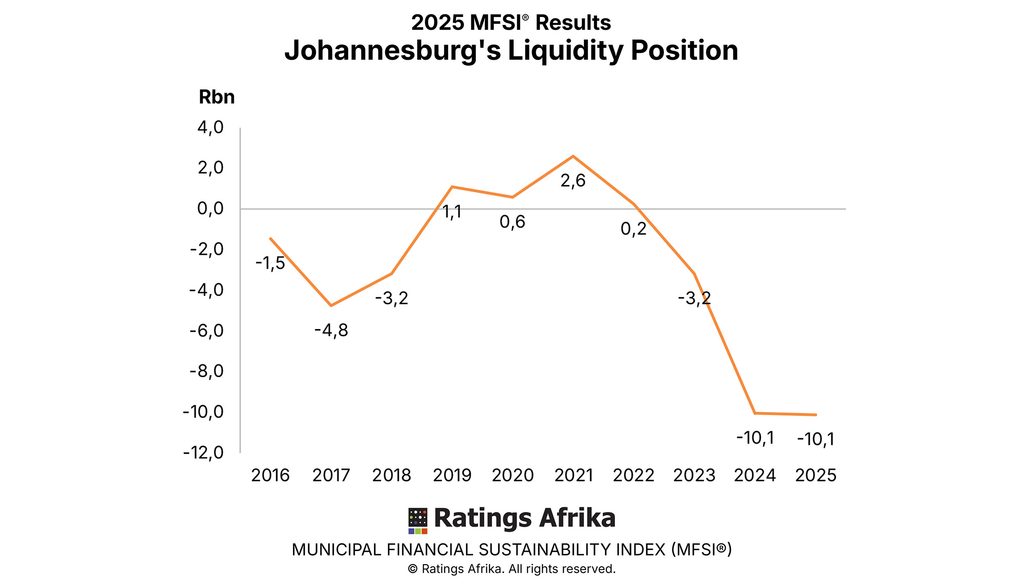
Johannesburg’s liquidity position over the last decade (R billion)
At the end of June 2025, the City of Johannesburg’s cash balance stood at only R4 billion, sufficient to fund approximately three weeks of operating expenditure, far below the prudent benchmark of approximately three months. This severe liquidity crisis largely explains the widespread breakdown in service delivery and the accelerating deterioration of municipal infrastructure across Johannesburg.
A further contributor to the Johannesburg’s financial crisis is its poor revenue collection rate of only 84,4%, more than 10 percentage points below the generally accepted benchmark of 95%. Unless revenue collection improves substantially, Johannesburg will continue its downward financial spiral and could ultimately face financial collapse.
Conclusion
The latest Municipal Financial Sustainability Index (MFSI®) confirms that the financial position of South Africa’s largest metropolitan municipality continues to deteriorate at an alarming pace. The resulting decline in service delivery capacity is having an increasingly damaging impact on residents, businesses and the local economy.
Unless there is a fundamental improvement in accountability by both elected councillors and executive management, supported by sound financial governance and responsible stewardship of public resources, Johannesburg’s challenges will only intensify. Service delivery will continue to deteriorate, infrastructure will decay further, economic growth will be constrained and the quality of life of the City’s residents will continue to decline.
Johannesburg has the resources, economic base and human capital to be one of the world’s leading metropolitan cities. What it lacks is effective governance, financial discipline and accountable leadership.
The City of Gold has not lost its potential, but unless decisive action is taken, it risks losing far more than its shine.
Contact
Leon Claassen
Managing Executive
Mobile: +27(0) 82 443 4046


0 Comments